• 0 Posts
  • 17 Comments
Joined 3 years ago
cake
Cake day: July 10th, 2023

help-circle


  • Reva@startrek.websitetoLinux@lemmy.mlNew Arch-based Distros
    link
    fedilink
    English
    arrow-up
    4
    ·
    3 years ago

    Why? There’s not many that actually do unique things. KDE/GNOME are the big ones, then plenty of macOS clones without much substance (i. e. Cutefish, Pantheon), the lightweighter Windows clones that all somewhat work the same (Xfce, LXQt, MATE, Liri), and that was basically it. They all do the same thing Windows or macOS do, featuring the same design choices and look and feel; oh look, a full-size taskbar with a clock in the right corner and a start menu in the left corner! Riveting.

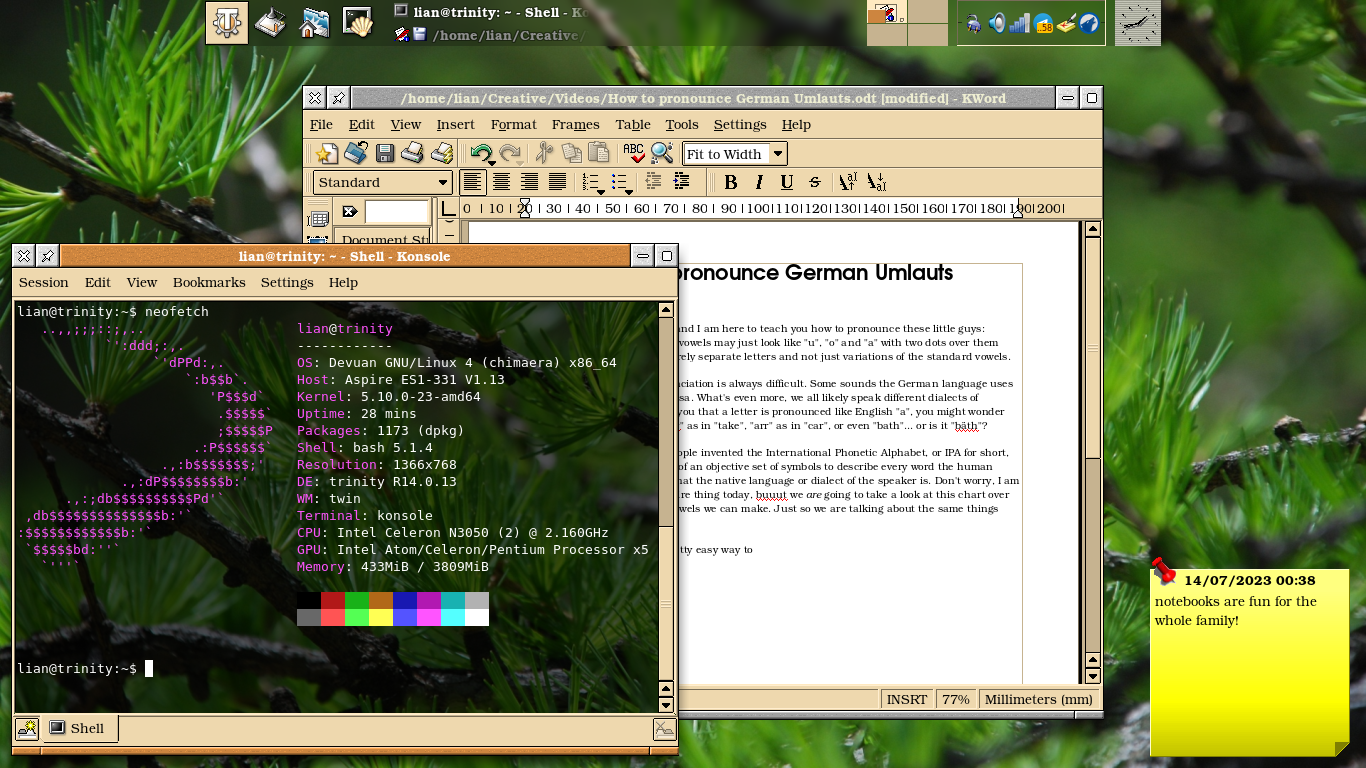
    The only ones that really have something unique going for them are Trinity, WMaker/GNUstep, Enlightenment/Moksha, CDE, EMWM and maybe Sugar. You’ll notice that they’re not exactly the most popular or well supported ones.

    Where’s really creative and innovative ones like ROX used to be? Where’s the funky 3D desktop environments? Where’s ones with completely new control schemes like a radial menu or a modern take on iconification? Where’s dockapps? Where’s innovation?


  • Reva@startrek.websitetoLinux@lemmy.mlNew Arch-based Distros
    link
    fedilink
    English
    arrow-up
    11
    arrow-down
    2
    ·
    3 years ago

    Too many distributions, not enough desktop environments. Distributions don’t really vary that much other than how they’re installed, what the release model and what the package manager is.

    What really matters is what you run on it, but for some reason people insist on “distro-hopping” and not on “desktop-hopping”.


  • I do use it daily, yeah. :)

    There are a bunch of paper cuts simply because their team is so small that maintaining technical integrity itself and refactoring (e. g. the move to python3 that was completed recently) is a monumental task in and of itself, with new features or bugfixes being a distant priority at best. That’s why there’s still some inconsistency whether some niche features really work or whether things are adapted to work with TDE instead of a stock KDE 3.5; up until I made a pull request to fix it a couple of weeks ago, Konversation still by default pointed to Freenode instead of Libera.Chat for example.

    I mean it makes sense, maintaining a desktop environment with dozens upon dozens of programs and features like KDE is really something that needs about as big a team as the KDE team itself was back then, and the handful of people who maintain TDE now are definitely not enough. There’s still apps without a dedicated maintainer, for example, who only have generalists looking if it compiles for every update. It’s not ideal.

    That all considered, it runs very well out of the box!

    As for positives, it’s my desktop of choice because I disagree with the design philosophy of modern DEs. It seems like they all tend to converge into the exact same direction. It’s all either a macOS knockoff or a Windows knockoff. I can’t even tell Plasma 5 from Windows by default! It has a taskbar on the bottom with a start button to the far left, the clock and date in the bottom right along with the tray and notification area. Desktop icons, right-click context menus, the same general UX. It looks, feels and works exactly like Windows 8-11!

    The flat and blur-heavy corporate design that was originally created to be as cheap and agreeable with as many people as possible to maximize profits is entirely uncritically copied by almost all desktops now. Every IRC/XMPP/Matrix client now needs to look like Discord or WhatsApp! I miss when there was still playfulness and personality in design; something like early video game UIs with crazy fonts, materials, textures, colors. UI widgets that felt physically hefty to use, like a button that actually looked like it depressed into something, or tactile, sharp scroll bars. Window decoration that was themed after fantasy creatures, or if you want it more professional, something like wood or marble. You know, something human!

    Even the app packages themselves show barely any divergence: every DE nowadays ships with Firefox or Chromium, for example; while in the past, almost every project had their own browser with different features and design goals. Remember Konqueror? I use it on the daily now and didn’t know how cool a file manager-browser hybrid was until I tried. I realize that this is a technical issue and not a motivation issue, but hello?

    Innovative features and really experimental design choices are also a thing of the past apparently: ROX Desktop with its drag-and-drop mantra, WMaker with its dockapps, the various 3D environments that cropped up over the years… hold left-click on an empty desktop for an application menu… iconified windows… it’s all gone. It’s all Windows or macOS clones now.


  • Darktable if you want to do professional photography editing, and GIMP if you want to modify graphics, pixelart, design flyers or handouts, posters, or whatever else you want to do in a raster editor.

    I have been using GIMP since fifth grade in school when we had an intro to photo manipulation, and since whenever I needed something edited, composited or designed. It blows my mind again and again that people online apparently find GIMP hard to use or unintuitive. It’s one of the most normal programs I have ever used. Photoshop on the other hand feels utterly inconceivable to me.